How to Get AdX (Google Ad Exchange) Approval | Abakwa Studio
1. Definition of Google Ad Exchange
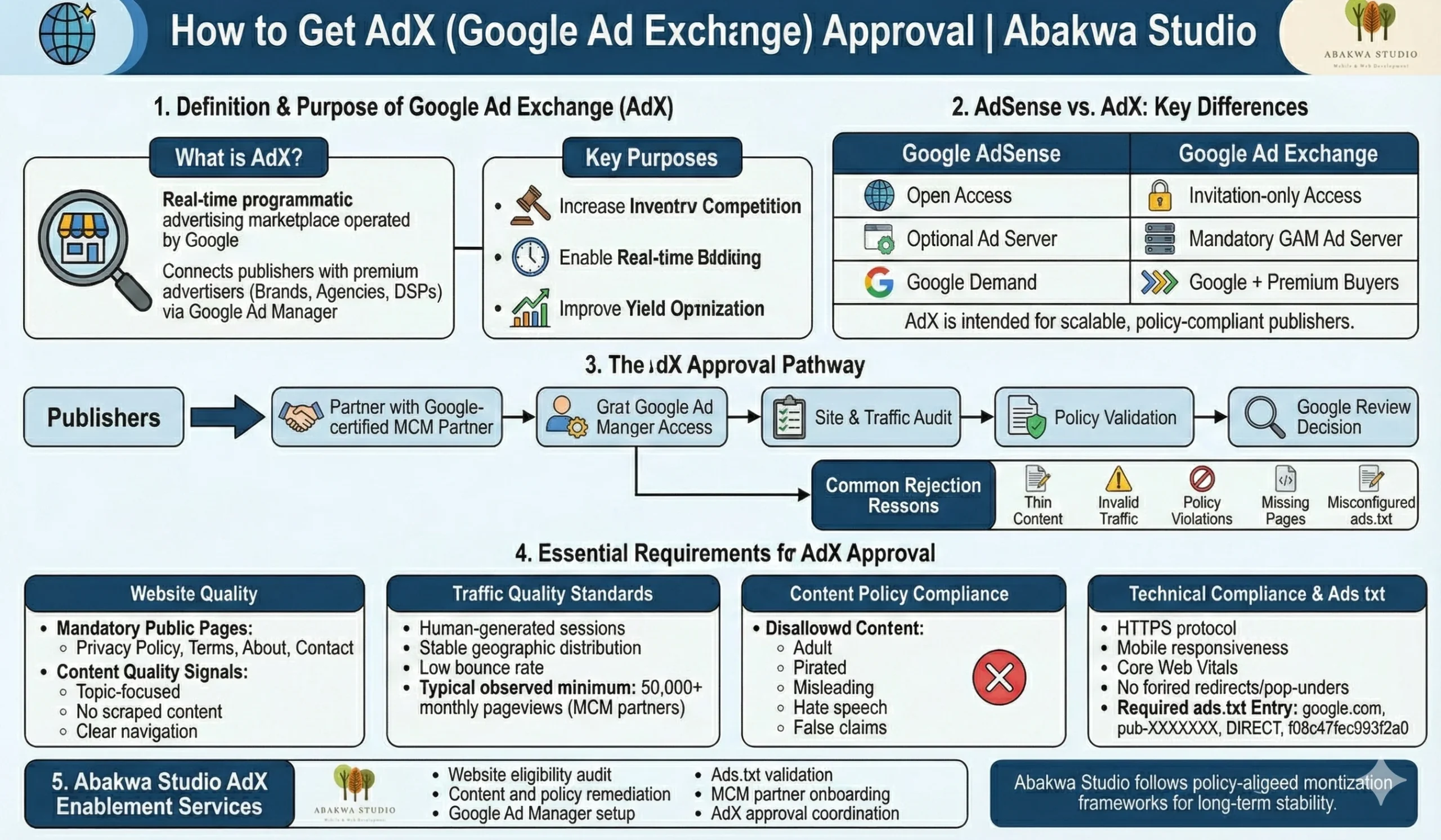
Google Ad Exchange (AdX) is a real-time programmatic advertising marketplace operated by Google. Google Ad Exchange enables publishers to sell digital advertising inventory through auction-based bidding mechanisms using Google Ad Manager (GAM) as the mandatory ad-serving platform.
Google Ad Exchange operates within Google’s programmatic ecosystem and supports real-time bidding (RTB), where multiple advertisers compete for each ad impression at the time the page loads. AdX inventory is transacted through server-side auctions, ensuring controlled access and policy enforcement.
Google Ad Exchange connects publishers with premium demand sources, including global brands, media agencies, trading desks, and demand-side platforms (DSPs). These buyers participate in auctions based on targeting criteria such as geography, device type, user signals, and inventory characteristics.
Google positions AdX as an enterprise-grade monetization platform intended for publishers that meet quality, traffic, and policy compliance standards.
2. Purpose of Google Ad Exchange
Google Ad Exchange is designed to improve publisher monetization efficiency by introducing competitive demand and transparent pricing mechanisms.
Core Objectives of Google Ad Exchange
-
Increase demand competition for each impression
-
Enable real-time bidding across premium buyers
-
Improve yield optimization through auction pressure
-
Maintain transparent and standardized auction mechanics
Google Ad Exchange replaces fixed or limited pricing models with dynamic auction pricing, allowing inventory value to be determined by real-time demand conditions rather than static CPMs.
According to Google Ad Manager documentation, AdX uses unified first-price auctions, where the highest bidder pays the amount they bid. This auction model reduces bid shading complexity, improves pricing clarity, and aligns buyer and publisher expectations.
Google states that unified auctions improve price discovery accuracy, meaning the final clearing price reflects actual market demand for each impression.
3. Difference Between Google AdSense and Google Ad Exchange
Google AdSense and Google Ad Exchange differ by access level, control, and infrastructure.
| Attribute | Google AdSense | Google Ad Exchange |
|---|---|---|
| Access Type | Open | Invitation-only |
| Ad Server | Optional | Mandatory (GAM) |
| Pricing Control | Limited | Advanced |
| Buyer Access | Google demand | Google + premium buyers |
| Traffic Scale | Low to medium | Medium to large |
| Approval Method | Direct | MCM Partner |
Google Ad Exchange is intended for scalable, policy-compliant publishers.
4. Eligibility Criteria for Google Ad Exchange
Google does not publish a fixed eligibility threshold for Google Ad Exchange. Approval is based on attribute evaluation rather than promises, projections, or estimated metrics. Google evaluates publishers using measurable quality, policy, and trust signals.
Core Eligibility Attributes
-
Ownership of an active Google Ad Manager account
-
Website compliance with Google Publisher Policies
-
Stable and legitimate traffic acquisition sources
-
Original and informational content
-
Valid user engagement and behavior signals
According to Google Publisher Policies (2023), Google Ad Exchange eligibility depends on inventory quality, traffic legitimacy, and publisher trust signals, rather than traffic volume alone.
5. Website Requirements for AdX Approval
Website quality is a primary eligibility determinant for Google Ad Exchange approval. Google evaluates both structural completeness and content clarity.
Mandatory Public Pages
-
Privacy Policy
-
Terms and Conditions
-
About Page
-
Contact Page
These pages establish legal transparency, publisher accountability, and ownership identity. All pages must be accessible, indexable, and clearly written.
Content Quality Signals
-
Topic-focused page structure
-
Informational and descriptive content
-
No scraped, spun, or duplicated text
-
Clear internal navigation hierarchy
-
Limited and non-intrusive ad density
According to a 2021 Stanford University Human-Centered AI (HAI) study, transparent content architecture and clear site structure improve platform trust evaluation and automated quality scoring.
6. Traffic Quality Standards for Google Ad Exchange
Traffic quality is evaluated using behavioral, geographic, and technical signals, not raw volume alone.
Accepted Traffic Attributes
-
Human-generated sessions
-
Stable geographic distribution
-
Balanced device usage (desktop and mobile)
-
Consistent engagement metrics
-
Absence of incentivized or manipulated clicks
Typical Observed Minimums Through MCM Partners
-
50,000+ monthly pageviews
-
Majority organic or direct traffic
Google uses Invalid Traffic (IVT) detection systems to identify bot activity, click manipulation, and artificial engagement patterns. IVT signals negatively impact AdX eligibility.
7. Content Policy Compliance for AdX
Google Ad Exchange strictly enforces Google Publisher Policies across all participating inventory.
Disallowed Content Categories
-
Adult or sexually explicit material
-
Pirated or copyright-infringing content
-
Misleading downloads or deceptive buttons
-
Hate speech, violence, or harassment
-
False or unverified medical or financial claims
According to Google Transparency Reports (2023), policy violations represent the most common cause of Google Ad Exchange rejection and account suspension.
8. Technical Compliance Requirements
Technical compliance ensures ad delivery integrity, measurement accuracy, and user safety.
Required Technical Attributes
-
HTTPS protocol enabled
-
Mobile-responsive design
-
Core Web Vitals compliance
-
No forced redirects
-
No pop-under, auto-refresh, or disruptive ad formats
Google Web Fundamentals documentation confirms that HTTPS is a mandatory requirement for monetized inventory, including AdX-enabled properties.
9. Google Ad Manager Configuration Requirements
Google Ad Exchange operates exclusively through Google Ad Manager (GAM). A misconfigured GAM account directly affects eligibility and approval timelines.
Required GAM Setup
-
Active Google Ad Manager network
-
Clearly defined ad units
-
Logical inventory hierarchy
-
Policy-compliant ad placements
-
Correct access permissions for partners
Incorrect or incomplete GAM configuration frequently results in review delays or rejection.
10. Ads.txt and Authorized Seller Declaration
Ads.txt validates authorized inventory ownership and seller relationships.
Required ads.txt Entry
According to IAB Tech Lab standards, ads.txt prevents domain spoofing, unauthorized reselling, and fraudulent inventory representation. Missing or incorrect ads.txt entries reduce trust signals.
11. Application Workflow for Google Ad Exchange
Publishers cannot apply directly to Google Ad Exchange.
Standard Approval Process
-
Partner with a Google-certified MCM partner
-
Grant Google Ad Manager access
-
Website and traffic audit
-
Policy and technical validation
-
Google review and decision
The review process typically lasts 7 to 21 days, depending on compliance readiness and inventory quality.
12. Common Reasons for Google Ad Exchange Rejection
Google Ad Exchange rejections follow consistent and identifiable patterns.
Primary Rejection Causes
-
Thin or low-information content
-
Invalid traffic signals
-
Policy violations
-
Missing mandatory legal pages
-
Misconfigured ads.txt file
-
Poor overall user experience
According to Google Ad Manager Help Center data, policy violations and traffic quality issues account for more than 70% of AdX rejections.
13. Approval Timeline and Review Signals
Approval speed depends on readiness and accuracy, not application date.
Key Review Signals
-
Compliance completeness
-
Traffic stability and legitimacy
-
Technical readiness
-
Accuracy of partner configuration
Incomplete remediation increases review cycles and may trigger re-evaluation.
14. How Abakwa Studio Enables AdX Approval
Abakwa Studio provides structured, policy-aligned Google Ad Exchange enablement services.
Services Offered
-
Website eligibility and compliance audit
-
Content and policy remediation
-
Google Ad Manager setup and optimization
-
Ads.txt validation and correction
-
MCM partner onboarding
-
Google Ad Exchange approval coordination
Abakwa Studio follows policy-aligned monetization frameworks to ensure approval stability and long-term compliance.
15. FAQs
Is Direct AdX Approval Possible?
No. Direct Google Ad Exchange approval is not available for most publishers.
Google Ad Exchange access is provided through the Multiple Customer Management (MCM) program. Under this model, a Google-certified MCM partner manages the onboarding, compliance validation, and inventory connection.
Google restricts direct AdX contracts to large enterprise publishers with established relationships, global traffic scale, and internal ad operations teams. According to Google Ad Manager documentation, standard publishers must use an MCM Manage Account or MCM Manage Inventory partner to gain AdX access.
Direct application attempts without an MCM partner result in automatic ineligibility because Google requires partner-level policy enforcement, billing management, and inventory governance.
Does AdX Guarantee Higher Revenue?
No. Google Ad Exchange does not guarantee higher revenue by default.
AdX provides access to additional demand sources and auction competition, but revenue outcomes depend on measurable monetization variables.
Revenue-Determining Attributes
-
Traffic quality and user intent
-
Geographic distribution of users
-
Ad viewability rate
-
Floor price configuration
-
Inventory size and placement
-
Demand competition density
According to Google Ad Manager yield optimization guidelines, higher CPMs occur only when auction pressure increases and inventory quality signals remain strong. Poor traffic quality or weak placements can result in CPMs equal to or lower than AdSense.
AdX improves revenue potential, not guaranteed earnings.
Can Small Websites Get AdX?
Yes. Small websites can receive AdX approval if compliance and quality thresholds are met.
Google Ad Exchange approval is not based on website size alone. Approval decisions rely on policy adherence, traffic legitimacy, and content value.
Conditions That Enable Smaller Sites
-
Original, topic-focused content
-
Clean traffic sources without incentivization
-
Stable session behavior
-
Complete legal pages
-
Proper Google Ad Manager setup
-
Valid ads.txt declaration
MCM partners often onboard smaller publishers when inventory quality meets Google’s trust requirements. According to Google Publisher Policies, invalid traffic risk and content violations, not pageview count, are the primary disqualifiers.
Site size influences scalability, not eligibility.